Santorini - The Island That Knows It's Beautiful
Santorini knows exactly what it's doing to you. It has always known. And it does not apologise for any of it.
You arrive — by ferry, by air, it doesn't matter, the island has already won before you set foot on it — and the thing that hits you is not what you expected. The photographs have been circulating for decades. The white walls, the blue domes, the improbable cliffside villages hanging over a caldera that was, let's not forget, a catastrophic volcanic explosion. The most Instagrammed place on earth, probably. You have seen it ten thousand times before you see it.
And then you see it. And it's still something.
The people are happy here. This sounds like the kind of soft observation a travel writer makes when they can't think of anything specific to say, but I mean it in the precise, slightly baffling sense: the Santorinians have figured out some ratio of pace and purpose that produces genuine ease. Laid back without being indifferent. Friendly without the transactional warmth of a place that's only being nice because it needs your money. You feel, against your better instincts, welcome.
The cruise ships arrive daily — multiple, enormous, white and grey monoliths queuing on the horizon like some slow-moving industrial convoy. In high season this would be the story. The overcrowding. The Instagram gridlock at the famous viewpoints. The forty-five-minute wait for a photograph in front of a windmill.
But in June — early enough, if you time it right — the numbers dissolve into the island's geography. Santorini absorbs its visitors with a kind of practised nonchalance. You turn a corner and the crowd simply isn't there. The caldera opens up beneath you and it belongs, improbably, to nobody in particular.
Make no mistake, however. This island has spent considerable time thinking about how to monetise the view.
It has concluded: aggressively.
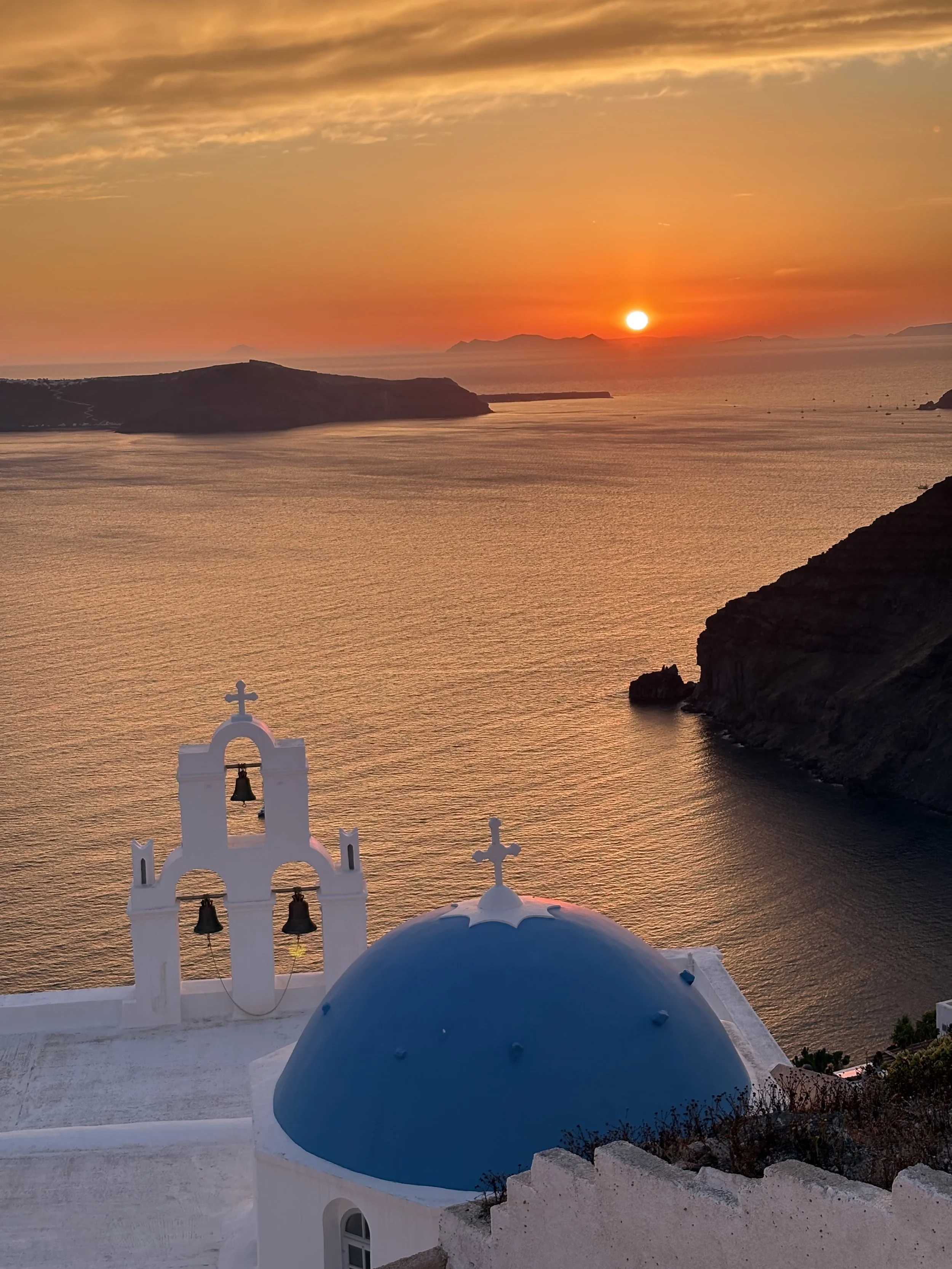
The sunset over dinner will cost you. Not an outrageous sum by any dishonest calculation — you are, after all, eating food and drinking wine with a view of one of the most spectacular geological formations on the planet — but the surcharge is real, embedded into the menu with quiet confidence. You are paying for the angle. The restaurant knows it. You know it. A brief, unspoken negotiation occurs at the moment you sit down and agree to look at the prices anyway.
The beachfront tavernas are less grand about it. Pull up a plastic chair at the edge of the Aegean, order something cold, and stare at the deep blue with the specific, stupid gratitude of a person who has been in a meeting too recently. The sea at Santorini is not a metaphor. It is simply, uncommonly, that shade of blue, and every photograph you take of it will be somehow inadequate, and you will take photographs anyway.
To reach the viewpoints, you have options. Both of them will test you.
The hike. Up the volcanic rock, in the heat, past walls that radiate the accumulated warmth of the afternoon sun. Your legs will register an objection. Ignore them. The view from the top — the island spread out below, the caldera, the Aegean horizon, the white geometry of the villages — is the kind of thing that briefly makes the concept of a bucket list seem reasonable rather than morbid.
Or the ATV. Which is, let's be honest, the correct choice if you want to cover ground, feel briefly reckless, and arrive at multiple viewpoints without depleting yourself. The roads are narrow. The gradients are biblical. You will, at some point, come around a bend and see something that makes you stop the vehicle entirely and stand there like a person who has forgotten how language works.
Either route delivers you to the same conclusion: the island has earned its reputation. The marketing is not a lie. The view is the product and the product is extraordinary.
Santorini is selling you something. It has always been selling you something. The prices, the angles, the choreographed sunsets, the sheer accumulated weight of everyone who has stood here before you and left wanting — all of it is commerce dressed as landscape.
But you buy it. You buy it completely. And walking back in the early evening, the light doing something unrepeatable to the white walls, you find you have absolutely no complaints about being sold to.
Some places just have the goods.